Growth in Productivity: The Positive, Negative, and Ugly
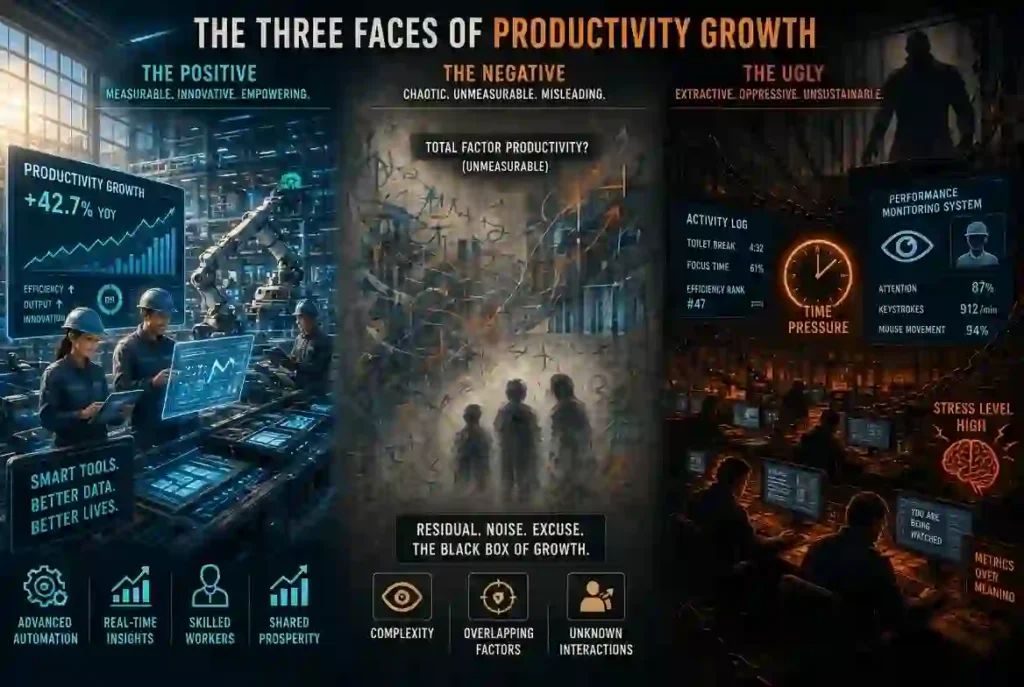
Productivity growth serves as our greatest statistical proxy Growth in Productivity for those desires, so if you care about innovation and material advancement, you also learn to care about it. Paul Krugman famously noted in “The Age of Diminished Expectations” that “productivity growth isn’t everything, but in the long run it’s almost everything.” Raising productivity per worker is nearly the only way for a nation to boost its standard of living.
I wish to emphasise in this essay how to 2.0 unreliable proxy productivity growth is. First of all, and this is a well-known fact, we can’t even measure the productivity growth that everyone is most concerned about. We begin with the crude measure of output per worker, or “labour productivity.”
However, if that number increases from year to year, it might simply be the result of a shift in the productive “quality” of labour (i.e., workers are generally slightly older and more experienced, or they are slightly better educated and trained), or it might be the result of additional purchases of machinery that enable increased production. We wish to focus on what economists call “total factor” or “multifactor” productivity growth: gains in output attained with specific labour and capital inputs.
The gap between the actual measured growth and the portions of growth that can be explained by higher labour or capital inputs is known as the “residual,” or leftover figure. Everything that we can legitimately attribute to input growth is subtracted from output growth, and the remainder is attributed to productivity gains.
Thus, total factor productivity is a “measure of our ignorance about the causes of economic growth,” as economist Moses Abramovitz famously stated.
It is evident that this phenomena is much more widespread than the sporadic discoveries that come from founders’ garages and corporate research labs once we have made every effort to separate productivity growth from output gains that merely reflect extra inputs.
Instead, fully realised innovation is a combination of invention and diffusion: before a new product or production technique can fully increase output, it must progressively draw in investment, labour, and, of course, consumers. Therefore, productivity growth includes both the effective reallocation of capital and labour resources toward these more productive applications as well as new and improved activities and methods of accomplishing them.
Indeed, it is evident that the main cause of the flagging dynamism issues facing the United States today is impeded dispersion. In recent years, the cost of producing solar and wind energy has decreased, but we are unable to take advantage of it because of delays in building out new production capacity and transmission lines; Operation Warp Speed was successful in developing effective COVID-19 vaccines in record time, but hundreds of thousands of people died needlessly because they believed anti-vax conspiracy theories or were simply reluctant to get a shot; and NIMBY restrictions on housing supply are preventing people.
Therefore, productivity growth must be a broad catch-all category that includes both innovation and diffusion if we are to assess economic progress accurately. This is because both are necessary to maintain economic output growing and material living standards rising. However, when we turn our focus from the “economic problem” to humanity’s “permanent problem” and examine the connection between innovation and leading “wisely and agreeably and well,” we discover that measured productivity growth is considerably too broad for this purpose.
Therefore, it’s safe to state that almost all workers nowadays have a far simpler time than their parents or grandparents did.
However, given we spend nearly half of our waking hours at work (or at least we did prior to the recent surge in working from home), better working circumstances are a crucial part of overall growing living standards. Therefore, the fact that new digital monitoring tools like Controlio are making working life significantly worse for an increasing number of employees should be truly disheartening to anyone who cares about human flourishing.
It is now feasible to monitor the websites that employees are viewing, their typing speed, the amount of time they spend on customer calls and the intervals between calls, the emails they send and receive, when they use the loo and how long they stay there, where they are right now, and where they have been throughout the day. It goes without saying that all of this spying increases stress at work and lowers job satisfaction.
You May Also Like

Texas Rangers vs New York Yankees Match Player Stats: Seager’s Two-Homer Night Leads Rangers to 7‑4 Win
The Texas Rangers leaned on a vintage Corey Seager performance to topple the Texas Rangers vs New York...
Read Story
New England Patriots vs Bengals Match Player Stats: Full Game Breakdown
By Jordan Mitchell, Senior NFL Stats Analyst | Updated July 26, 2026 Finding reliable New England Patriots vs...
Read Story
PRAGMATIC88: A Guide to Online Gaming Platforms and Features
Online gaming has become a popular form of digital entertainment. Many platforms now offer different games, simple interfaces,...
Read Story