The Open-Weights Gap Is 12 Points Today. Kimi K3.1 Pro’s Weights Would Make It 3
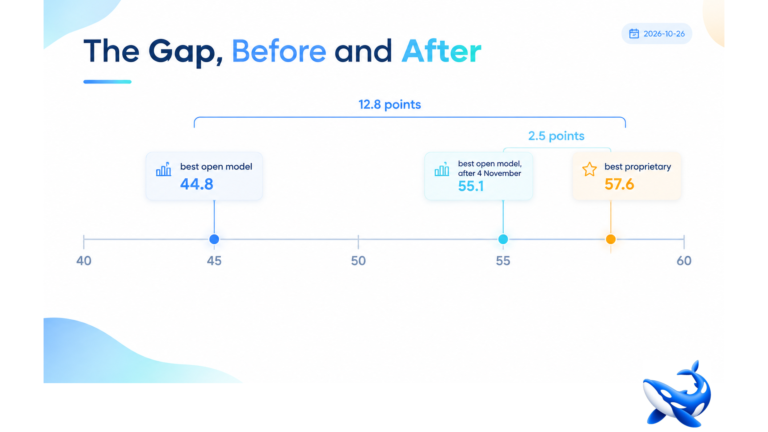
The distance between the best open-weight model and the best model of any kind is currently 12.8 index points: GLM-5.3 at 44.78, Claude Opus 5.5 at 57.62 [INDEPENDENT, index v4.3.2, 26 October]. Kimi K3.1 Pro scores 55.09, which would put a downloadable model 2.53 points from the top — the narrowest open-versus-proprietary gap anyone has measured. The catch is the tense. The weights are promised by 4 November 2026 and, as of today, do not exist; the independent evaluator labels the model proprietary, because that is what it can call [VENDOR / INDEPENDENT]. The OrcaRouter card for Kimi K3.1 Pro describes the API model at list price, which is the only form available today.
The evaluator’s own summary of the release is the arithmetic above, stated as a gap narrowing from 12 points to 3. That framing is worth understanding, because a twelve-point gap and a three-point gap are not the same commercial situation, and the difference is not only about who can download a file.
The arithmetic, checked
| Model | AA index | Weights available | Role |
| Claude Opus 5.5 (Max) | 57.62 | No | Best overall |
| Kimi K3.1 Pro | 55.09 | Promised 4 Nov | Would be best open |
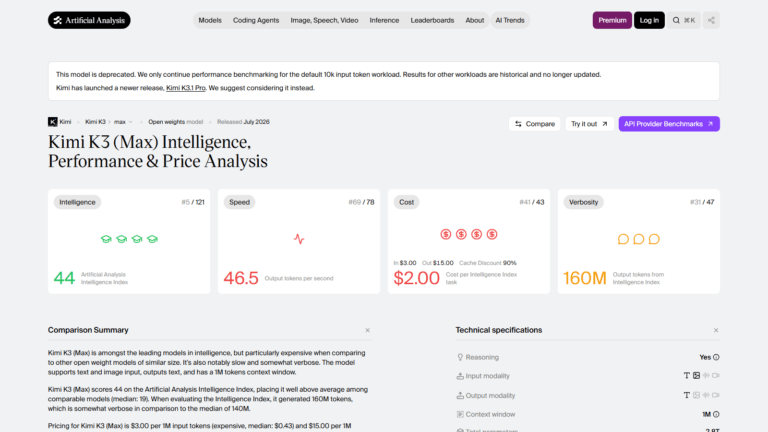
| Kimi K3 (Max) | 43.59 | Yes, commercial licence | Superseded, open |
| GLM-5.3 (Max) | 44.78 | Yes | Best open today |
| Kimi K2.7 Code | 25.81 | Yes | Small open coder |
| Gemini 4 Argon | 52.56 | No | Closed |
Today: 57.62 − 44.78 = 12.84. On 4 November, if the full checkpoint ships: 57.62 − 55.09 = 2.53. Same index version, same day, so the comparison is clean in a way that cross-version comparisons are not.
There is one honest caveat in the second line: an evaluation of an API endpoint is not necessarily an evaluation of downloadable weights. Serving stacks, quantisation and inference frameworks all move scores, usually downward. A 2.5-point gap is small enough that a self-hosted deployment could close it entirely or lose it depending on the stack — which is the argument for benchmarking the download against the API rather than assuming equivalence.
Why a 12-point gap and a 3-point gap are different businesses
The open-versus-closed gap has been the single most stable feature of this market: closed models lead by a margin large enough that an open model was never the right default for frontier work. Twelve points is roughly the difference between fourth place and the middle of the table — enough that “just host it yourself” was a cost argument, not a capability argument.
Three points changes the conversation in three ways.
Procurement. A regulated buyer who cannot send data to a third-party API has, until now, been choosing a model around twelve points behind. At three points, the question becomes whether the deployment cost is worth the residual gap — and for a bank comparing a $30 million self-hosting programme against a two-and-a-half-point capability difference, the answer can go either way for the first time.
Price. A downloadable frontier model imposes a ceiling on API pricing, because a competitor can serve the same weights. Kimi K3.1 Pro already launched a third below its predecessor on every billed line [VENDOR]; open weights constrain the next move in the other direction.
Vendor lock. A model you can host is a model you can keep after a vendor changes its terms, its prices or its rate limits. At twelve points that insurance was expensive; at three it is cheap.
What stays the same on 5 November
The gap is about capability. It is not about the bundle of things an API provides, and those do not transfer with the weights.
Serving quality. A 2.8T-parameter mixture of experts is a multi-node deployment. Most teams will rent it from someone rather than run it, and the quality of that someone’s stack determines your latency, uptime and cache behaviour. Our own measurements on this model show a p50 of 6.75 seconds across a seven-day window, rising slightly over three days [OURS]; that number belongs to the serving stack, not the weights.
Safety behaviour. The cyber-capability reduction is in the checkpoint [VENDOR]. A self-hosted copy is exactly as capped as the API, and a third-party host cannot raise the ceiling either.
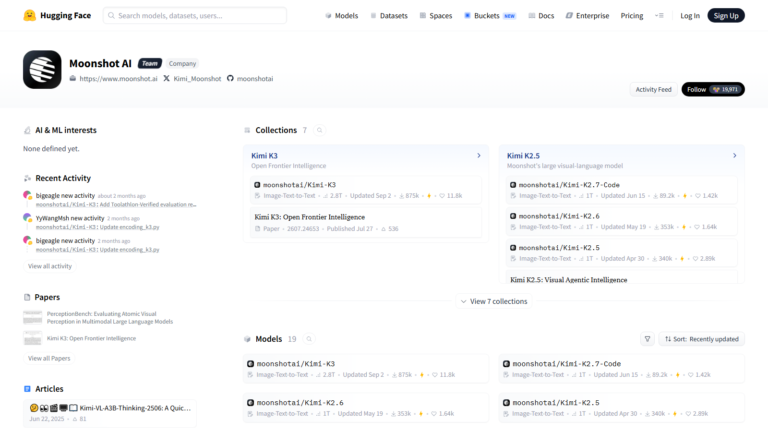
Licence terms. The K3 template included a commercial threshold for model-as-a-service providers reported at $20 million a year [VENDOR]. If K3.1 Pro carries a similar clause, the “free model” is free for fine-tuners and not for anyone reselling inference at scale. Read it on the day.
Tooling. Prompt caching, tool calling, structured output and the three API surfaces — Chat Completions, Responses and Messages — are served features. A self-hosted deployment reimplements them, and the caching economics that make this model affordable at long context (95% of input billed as cached reads) are the hardest part to reproduce.
Cost is the other variable, and it does not move either. Downloading weights does not make inference free; it moves the cost from a per-token meter to a per-hour GPU bill. A rough floor: serving a 2.8-trillion-parameter mixture needs memory for the full weights plus the KV cache for your context length, which is a multi-node deployment before anybody sends a request. For most buyers the honest comparison on 5 November is not self-host versus API; it is one API vendor versus another.
What to watch on the day
The number that will settle the story is not the release announcement. It is the first independent evaluation of the downloaded checkpoint, compared against the API row. If a self-hosted run reproduces 55.09 on the index, the open-versus-closed gap really is three points and the market’s most stable fact has changed. If it lands at 50, the gap is eight and the announcement was about intention rather than parity.
Until then, the accurate sentence is: the best model that can be downloaded on paper scores three points off the leader, and the best model that can be downloaded today scores thirteen.
For a buyer, that distinction is a planning date rather than a purchasing decision. Nothing you can call today changes; what changes is whether the next model you build needs to be portable. The announcement and the artefact are different events, and only one of them changes what you can call.
Sourcing note: all index scores, including GLM-5.3 at 44.78 and Opus 5.5 at 57.62, are Artificial Analysis on index v4.3.2, read 26 October 2026; AA also supplies the “12 points to 3” framing and the open-weights status of each model. The 4 November weights date, the K3 licence terms and the cyber-capability reduction are Moonshot’s. The p50 figure is our own seven-day routing telemetry. The 12.84 and 2.53 arithmetic is ours, computed from the published rows.
You May Also Like

Decoupling the Spread: The Most Reliable Handicap Favorites and Underdogs of the 2014/2015 Serie A Season
In the highly tactical ecosystem of Italian football, a team’s success in covering the Asian Handicap requires a...
Read Story
AFC Bournemouth vs Man City Stats: 7 Proven Numbers That Reveal the Real Gap
The Numbers Behind the Cherries vs The Citizens Every time AFC Bournemouth lines up against Manchester City, the...
Read Story
Seattle Mariners vs Los Angeles Angels Match Player Stats: Full Breakdown & Analysis
Finding clear, accurate player stats after a Seattle Mariners vs Los Angeles Angels game frustrates many fans. Raw...
Read Story